The inventor
William Lee of Calverton, near Nottingham, is credited with inventing the stocking frame in 1589. Little is known for certain about him, though he is usually described as a clergyman.
A royal refusal
The early frame made coarse fabric. Queen Elizabeth I is said to have refused Lee a patent, reportedly saying she would consider it if the machine could make fine silk stockings. Her successor, James I, also declined.
From invention to industry
Lee’s frame spread slowly, but over the next two centuries framework knitting became the main industry of Nottinghamshire, Leicestershire and Derbyshire. You can see stocking frames at the museums in Wigston and Ruddington.
How the frame worked
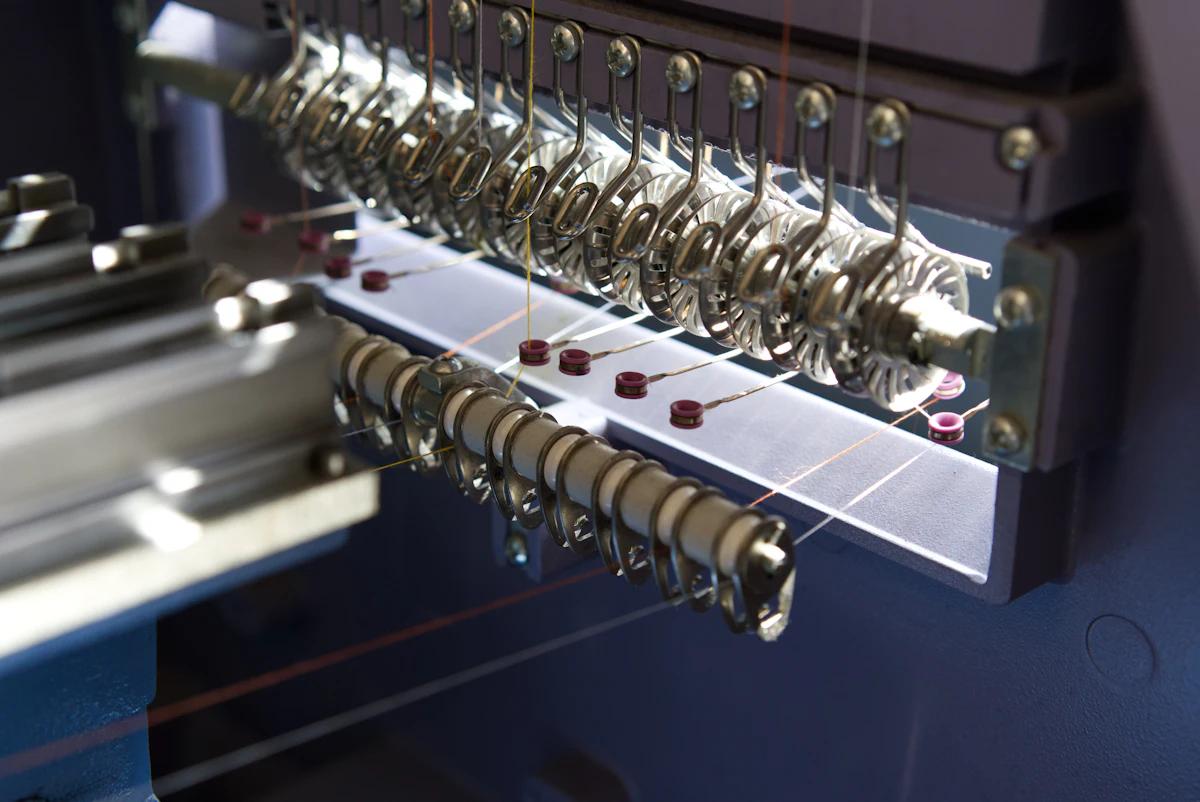
The stocking frame used a row of bearded needles, each with a springy hook. The knitter laid yarn across the needles, formed loops with sinkers, pressed the beards closed and pulled the new loops through the old. Repeat, and a flat piece of knitted fabric grew row by row. Stockings were shaped by adding and removing stitches and then seamed up the back.
Why the frame mattered
Hand knitting a pair of stockings took a long time. The frame was much faster and produced even, consistent fabric. Over time this changed hosiery from a slow cottage craft into an industry employing thousands of people in the East Midlands.
From hand frames to power
For two centuries frames were operated by hand and foot. In the 19th century, inventors added power, wider frames and new mechanisms, and by the end of the century most knitting was done in factories. The modern descendants are the circular and flat knitting machines in today’s factories.
Lee’s legacy in France
According to traditional accounts, after failing to win royal support in England, Lee took his frames to France, where he is said to have died around 1614. His brother and workmen later brought the frame back to England, where the trade took root in London and then the East Midlands.
Same principle, modern machines
Today’s knitting machines and the overlockers and coverstitch machines that sew knitted garments are distant descendants. Leicester workrooms still rely on them, supported by specialists such as PK Sewing Machines. Read about Leicester’s hosiery heritage.
Last updated: 14 October 2026


